
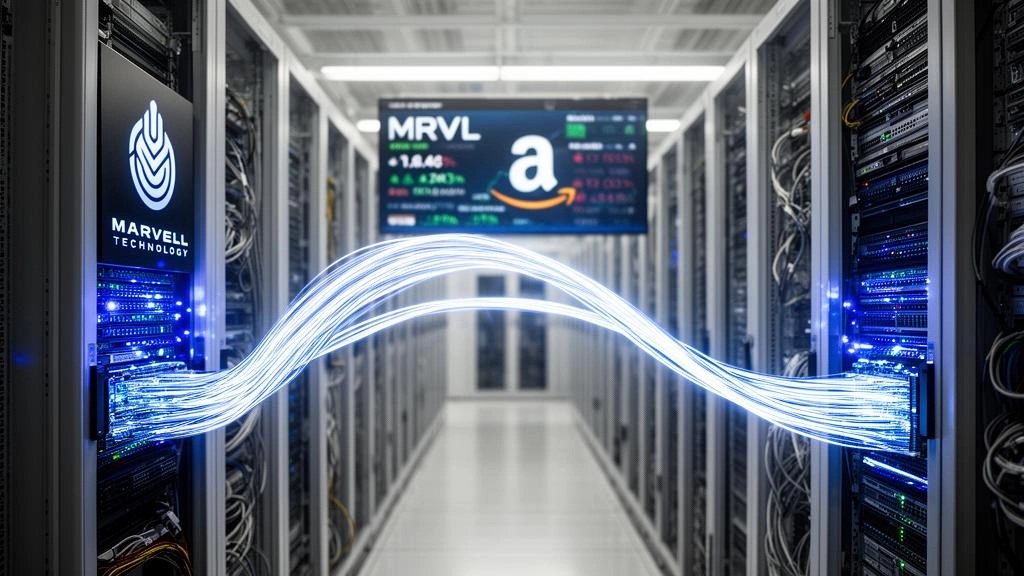
Marvell Technology (MRVL) is betting that the next phase of artificial intelligence will do more than just train bigger models—it will force a fundamental rewiring of data centers. As AI systems begin to interact autonomously with each other in sprawling, multi-step workflows, the company argues that networking, optical interconnects, and custom silicon will become just as critical as the GPUs that have dominated the infrastructure boom so far.
"We expect the emergence of Agentic AI to further supercharge demand," Chairman and CEO Matt Murphy told analysts on a conference call following the company's fiscal first-quarter results. His comments framed agentic AI—where models act independently across clusters rather than simply responding to single prompts—as a catalyst that could dramatically reshape infrastructure requirements.
The upbeat outlook came alongside a strong quarterly report. For the period ended May 2, Marvell posted record revenue of $2.418 billion, a 28% jump from a year earlier and slightly ahead of the $2.41 billion consensus estimate. Adjusted earnings per share came in at $0.80, edging past the $0.79 analysts had forecast. Non-GAAP gross margin held at 58.9%.
Despite the beat, MRVL shares slipped 4.59% during Wednesday's regular session to close at $198.70. But the after-hours reaction told a different story, with the stock climbing nearly 7% as investors digested a second-quarter guidance that blew past expectations.
Guidance Surge Reflects AI Order Boom
For the current quarter, Marvell expects revenue of $2.70 billion at the midpoint, plus or minus 5%, far above the $2.60 billion that Wall Street had penciled in. That would represent 35% year-over-year growth. The company also forecast adjusted earnings of $0.93 per share, comfortably ahead of the $0.90 consensus.
More significant were the raised full-year targets. Marvell now sees fiscal 2027 revenue of around $11.5 billion, up roughly 40% from the prior year. Three months ago, management had guided to "approaching $11 billion." Looking further out, the fiscal 2028 revenue target jumped to approximately $16.5 billion—an increase of about $1.5 billion from the previous forecast—implying another 45% growth spurt.
"We are seeing exceptional AI-related bookings, and as a result, we are significantly raising Marvell's revenue outlook for both fiscal 2027 and fiscal 2028 compared with the guidance we provided last quarter," Murphy said. The improved outlook is "driven by strong demand across a broad set of Marvell solutions," he added, citing 800G and 1.6T scale-out optics, 51.2T Ethernet scale-out switches, scale-up optical solutions for near-packaged optics and co-packaged optics applications, scale-across data center interconnect modules, and custom XPU and XPU-attach solutions.
Data Center Dominance
The data center segment, which now accounts for 76% of total revenue, exemplifies the momentum. First-quarter data center revenue reached $1.833 billion, up 27% year-over-year. Within that, the data center interconnect (DCI) business—Marvell's largest data center sub-segment, covering optical interconnect, DCI modules, and coherent optics—has seen its annual growth rate revised upward for several consecutive quarters and now exceeds 70%.
Murphy made clear that the AI infrastructure story is no longer just about compute. "Early generative AI primarily addressed compute and memory bottlenecks; networking was a secondary concern," he explained. "But with the deployment of more complex architectures like reasoning models and mixture-of-experts, the volume of data moving within AI clusters has surged dramatically, making networking far more important."
The CEO argued that agentic AI will take this dynamic even further. "Agentic AI is expected to drive a significant increase in the number of CPUs deployed in AI infrastructure," Murphy said. That marks a departure from the narrative that has dominated Wall Street, where the AI buildout has been almost synonymous with GPU capacity.
Custom Silicon Ambitions
Marvell's custom chip business—referred to as Custom/XPU—is emerging as another major growth pillar. The company expects this segment to grow more than 20% in fiscal 2027, then double in fiscal 2028 before surpassing $10 billion in fiscal 2029. That target is up from a prior goal of $8 billion, reflecting an increasing number of design orders and contracted customer projects.
The company's role in helping large technology firms design and manufacture their own AI processors has made Marvell's outlook a bellwether for AI infrastructure spending. According to a Reuters report cited by market participants, U.S. tech giants including Alphabet (GOOGL) and Amazon (AMZN) are expected to spend more than $700 billion on AI infrastructure this year, a sharp increase from roughly $400 billion in 2025.
Acquisition Costs Weigh on GAAP Results
While the operational picture was bright, GAAP net income told a more complicated story. Marvell reported net income of just $34.5 million, down sharply from $177.9 million a year earlier. The decline stemmed from one-time charges and non-cash amortization tied to the acquisitions of Celestial AI and XConn—moves that expand Marvell's optical interconnect and switching capabilities but carry near-term accounting costs.
Investor sentiment on retail platforms reflected the mixed signals. On Stocktwits, retail sentiment for Marvell flipped to "extremely bullish" from "bullish" a day earlier, with message volume reaching "extremely high" levels. Over the past seven days, message volume surged 364.6%, while the 90-day jump exceeded 655%. MRVL stock has gained nearly 133% year-to-date and more than 215% over the past 12 months.
The Early Innings Thesis
Murphy's comments reinforced an idea that is gaining traction across the semiconductor industry: the AI infrastructure buildout may still be in its early innings. While much of the initial spending focused on training ever-larger models, the shift toward inference, reasoning, and autonomous AI agents is creating new bottlenecks in data movement, switching, and optical connectivity.
Marvell is positioning itself at the center of that shift. If agentic AI lives up to the hype, the company's argument that networking complexity will become the next great infrastructure challenge could prove prescient—and highly profitable.
Once added, BigGo Finance appears first in Google Search Top Stories, so you get the broadest, most up-to-the-minute, and most comprehensive global financial news first.