
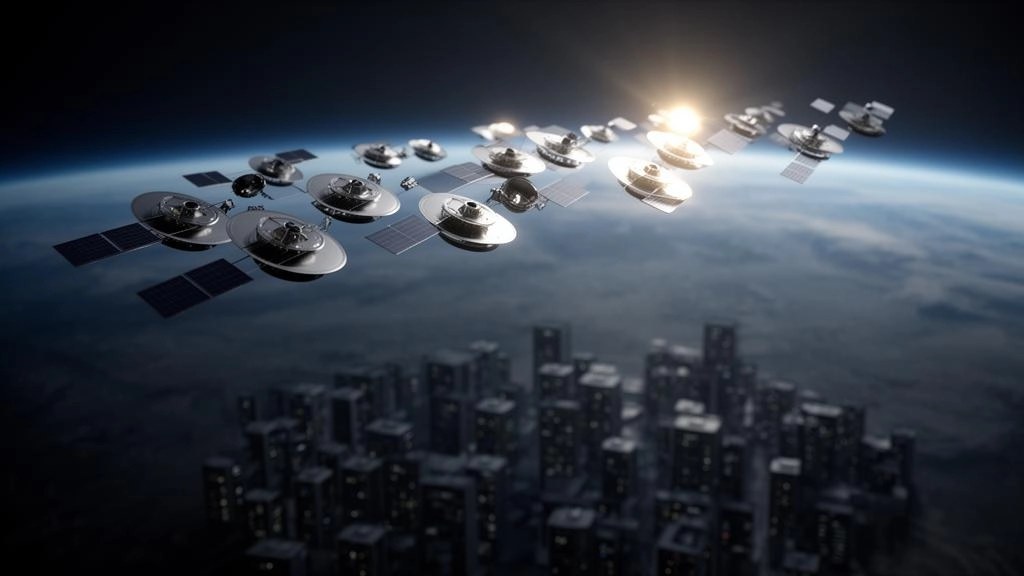
It costs roughly $1,000 to launch a kilogram of payload into orbit today. That number has fallen by an order of magnitude over the past decade, driven largely by SpaceX's reusable rockets. Will Marshall, CEO of Planet Labs, says it needs to fall just one more notch — to somewhere between $200 and $300 per kilogram — for the economics of computing to flip upside down. At that threshold, according to research Planet conducted with Google, building and operating a data center in space becomes cheaper than building one on the ground. Marshall expects Starship, SpaceX's next-generation launch vehicle, to hit that number within two to three years.
Speaking on the All-In podcast's IPO panel alongside Cerebras CEO Andrew Feldman, Marshall laid out the arithmetic that makes this more than a thought experiment. A solar panel placed in a sun-synchronous dawn-dusk orbit collects roughly five times more energy than the same panel on Earth's surface, with no need for battery storage or backup generation — the sun never sets in that orbit. There's no land to buy, no cooling towers to build, no grid connection to negotiate. "Just solar panels, chips, and RF links," as Marshall described it.
Jason Calacanis, the angel investor and podcast co-host, pushed the logic further: within ten years, he predicted, most of the world's compute will reside in space, representing trillions of dollars in value and dwarfing every other space business combined. Feldman, whose company manufactures the largest computer chip ever built, offered a more measured timeline. "I think it's an extraordinarily important and interesting problem," he said. "I've got it in a slightly different time frame, but one that certainly will occur." His caution comes from hard experience: the last ten percent of any hard engineering problem, he noted, often consumes eighty percent of the effort — self-driving cars being the canonical warning.
Two IPOs, One Unvarnished Truth
Feldman and Marshall arrived at this conversation from strikingly similar trajectories. Both spent roughly a decade building companies that looked contrarian at the start. Both went public. And both discovered that the IPO process, for all its fanfare, changes surprisingly little about the actual business.
Feldman, whose company Cerebras had priced its IPO at $185 per share just three weeks earlier — opening at $320 before settling around $230 — was characteristically blunt. The process was filled with "garbage," he said: endless Zoom meetings with 130 attendees, review cycles where "commas move" and nothing of substance changes. The morning after the bell, the company had sold no more products. Engineering projects remained at exactly the same point. "Not a damn thing changes in the important parts of your business," he told the audience. The only genuine improvement was a larger bank account, which helps with supplier credibility when you're placing enormous chip fabrication orders.
Marshall, speaking from four years of experience as a public company CEO after Planet Labs went public via SPAC merger in 2021, offered a complementary perspective. Being listed is "legitimizing" for customers — especially the government and defense agencies that increasingly depend on Planet's daily stream of satellite imagery and need assurance the company will still exist in five years. The employee morale bump from a public listing is real. The external validation helps close enterprise deals. But the core message was the same as Feldman's: "In the end, you have to get on with executing the business," Marshall said, regardless of where the stock trades on any given day.
The numbers behind their two journeys tell a story about the different paths to public markets — and the different outcomes they produced.
Brad Gerstner, founder of Altimeter Capital and a board member at Cerebras, framed the bigger structural shift. "We had this period of a decade where Andreessen was really pushing 'stay private forever,'" he said, "and I see the pendulum swinging back to companies saying 'I want to be like Planet Labs and get public.'" His argument is that the largest absolute dollar gains in technology investing have historically come after the IPO, not before it. Feldman agreed, noting that venture-backed companies can only deploy so much capital while private — but once public, the compounding can begin in earnest. "More money is made after IPO than before," he said.
The Architecture Bet: Why Cerebras Cannot Look Like Nvidia
If the space data center debate anchors the far horizon of this conversation, Feldman's chip architecture represents the near-term battle already underway. His thesis, formed around 2015 and 2016 when AI workloads first emerged as a distinct computing category, was built on a historical pattern: new workloads always shift market share. Graphics gave rise to Nvidia's GPU. Mobile computing dethroned Intel in client devices. Networking created Cisco. AI, Feldman bet, would do the same — and the winner would not look like what came before.
The bottleneck that defines modern AI compute is not raw processing power but the distance data must travel between memory and the cores that compute on it. Engineers call this the "memory wall." In a GPU, memory sits off-chip on high-bandwidth modules — fast, but still separated by physical distance and bandwidth constraints. Cerebras's solution was radical: build a chip the size of an entire silicon wafer — a dinner plate — and place memory directly adjacent to every compute core, using a faster memory technology than the GDDR or HBM found in GPUs. The result is a single massive die where data barely has to move.
"If you want to be 20 times better than somebody, your architecture can't look like them," Feldman said. "If you build a GPU, the odds that you're better than Nvidia are approximately zero." The practical outcome: when OpenAI runs inference on Cerebras hardware, it executes 15 to 18 times faster than on a GPU.
That speed advantage is not a luxury feature. Gerstner framed the stakes with an analogy that cuts through technical jargon. "How big is the market for slow search today? Zero," he said. "How big is the market for dialup? Zero." His point: users who experience three to five seconds of latency in an AI interaction will click away, just as they abandoned slow-loading web pages two decades ago. Real-time AI inference, in this view, is not a premium tier — it is the only tier that will matter. Cerebras is betting its architectural divergence can make it the default engine for that real-time future, complementing Nvidia in the training domain while potentially displacing it in deployment.
200 Satellites, One Daily Portrait of Earth
Marshall's contrarian bet was in a different domain but followed the same structural logic. For decades, Earth observation satellites were the province of governments: billion-dollar machines the size of school buses, built one at a time, launched rarely. Planet Labs inverted that model. It operates roughly 200 small satellites — each weighing a few hundred kilograms, each costing a fraction of the traditional price — that together photograph the entire land surface of the Earth every single day.
"It's the same as the sort of mainframe computer to desktop revolution for space," Marshall said. Two concurrent trends made it possible: launch costs have fallen four to five times over the past decade, and satellite components have miniaturized to the point where a capability that once required 20 tons of hardware now fits in something the size of a carry-on suitcase. The output is a daily time-series of the physical planet — crop health in Iowa, pipeline integrity in the Middle East, flood extents in Bangladesh — updated every 24 hours.
Marshall estimates the addressable market for Earth observation data alone at $75 billion to $100 billion. But the larger opportunity, in his view, is what happens when this data stream meets large language models. Today's AI systems, trained on text and images scraped from the internet, are what he calls "blind" to the physical world. "They don't know about that farm field, that flood, that security situation around the corner," he said. "If you give them real-world data, they can answer real-world problems." He envisions "large earth models" — AI systems trained on daily planetary imagery — that could answer questions no text-based chatbot can touch: Is this specific field flooding? Has that military installation changed since last week? Where will the next fire break out?
A growing share of Planet's revenue now comes from defense and security customers, a shift Marshall attributes to heightened geopolitical tensions. But he emphasized that the company's core mission spans commercial agriculture, energy infrastructure monitoring, and civil government applications like disaster response — and that the AI layer is what will unlock value across all of them.
When Does Compute Leave the Planet?
The most provocative exchange of the conversation came when Marshall's space data center thesis collided with Feldman's engineering pragmatism. Marshall sees the path as clear: launch costs are falling on a predictable trajectory, solar power in orbit is vastly more efficient, and the infrastructure requirements are simpler than those on Earth. Planet has already partnered with Google to test Google TPUs in space; earlier experiments flew Nvidia GPUs. The technology works in principle. The question is cost, and Starship, in his view, is the vehicle that closes the gap.
Feldman did not dismiss the vision. But he introduced a note of caution that reflects the difference between a satellite operator who has solved orbital hardware problems and a chip designer who knows what happens when you try to scale computing clusters. "One or two hard problems" remain, he said — inter-chip communication at scale being the most significant. In a terrestrial data center, chips are connected by high-bandwidth fiber and copper links measured in meters. In orbit, a cluster spread across multiple spacecraft would need to coordinate across kilometers of vacuum, with radiation hardening and thermal cycling adding layers of complexity. Feldman's experience with self-driving cars, where the industry spent a decade solving ninety percent of the problem only to stall on the final ten percent, shapes his skepticism about optimistic timelines.
The two timelines are worth comparing directly.
The economics that make this debate worth having are not speculative. SpaceX's launch costs have already dropped roughly tenfold in ten years. The $200-to-$300-per-kilogram threshold that Planet and Google identified as the breakeven point is within sight of Starship's projected capabilities. And the demand side is only growing: AI workloads are expanding faster than terrestrial data center capacity can keep pace, while the energy requirements of ground-based facilities are running into grid constraints and public opposition in many regions.
The Dribble Lockup and the New IPO Playbook
Beneath the technology narratives, the conversation surfaced a structural innovation in how companies go public. Cerebras implemented what Gerstner called a "dribble lockup" — a mechanism that allows insider shares to be sold gradually over six months according to performance hurdles, rather than facing a single cliff date where the entire float could flood the market. Gerstner noted that SpaceX is likely to adopt a similar structure for its own anticipated IPO, which reference reports suggest could be the largest in history at a target valuation exceeding $1.8 trillion.
The dribble lockup is more than a technical tweak. It addresses one of the ugliest dynamics in technology IPOs: insiders racing to sell on the one day they are permitted, cratering the stock and poisoning the experience for retail investors who bought at the offering price. By metering liquidity over time with performance conditions, the structure lets early investors begin to exit without destabilizing the market — and gives public shareholders confidence that insiders are not dumping overnight.
This innovation fits into a broader argument Gerstner made about who captures the value of great technology companies. He contrasted two models.
Gerstner's punchline was pointed: "A lot of people think Anthropic, OpenAI, and SpaceX are the new normal. I actually think the public markets may be shifting back in this direction, and a lot of the companies in our portfolios are now thinking about going public at a billion or three billion or five billion." The implication is that the decade-long trend of companies staying private until they were worth hundreds of billions may have been an aberration — and that firms like Planet Labs, which went public at $2 billion and then compounded tenfold in the open market, represent a fairer allocation of that wealth creation.
Feldman, reflecting on his own nine-and-a-half-year journey to the public markets, captured the absurdity of timing. He spent years failing to go public, then twelve months where "everybody wanted to get in." The timing was not skill, he admitted — it was simply persistence. Marshall's closing wisdom was even simpler: the stock price moves, the constituencies multiply, but the engineering, the supply chain, and the customer value proposition are the same the day after the IPO as the day before. The companies that survive are the ones whose leaders understand that the bell ringing is noise, and the work is signal.
For investors, the episode frames a choice that is becoming harder to ignore. The most ambitious technology infrastructure of the next decade — wafer-scale AI chips, daily Earth imaging, orbital data centers — is being built by companies that are choosing to go public earlier and with more innovative liquidity structures. If Gerstner is right that the pendulum is swinging back toward public markets, the opportunity to buy into these platforms at single-digit or low-double-digit billion valuations — and ride the compounding that Feldman insists happens primarily after the IPO — may not last. The alternative is to wait for the mega-IPOs at trillion-dollar valuations, where the math of catching the next tenfold move becomes considerably more difficult.
- Jensen Huang Mania Sweeps In: Taiwan Stocks Surge Past 45,000 Points to Record High Before Pullback, AI Hardware Frenzy Erupts
- AI Fever Grips Wall Street: HPE and Marvell Surge as Microsoft Build 2026 Kicks Off
- SpaceX IPO Reportedly Set at $135 Per Share, Aiming to Raise $75 Billion in Record-Breaking Listing
- Dow Soars Over 800 Points to Record High as Dalio Warns AI Bubble Shows Classic Signs
- SpaceX-Tesla Merger Speculation Intensifies Ahead of Record IPO, but Deal Faces Major Structural and Shareholder Hurdles